
How Hardscapers Turn New Tech Into Predictable Profit and Long‑Term Wealth
"I think that so often we lead and manage our businesses like reptiles, which is just completely reactive. Their goal is to just not die today. There's no love. There are no long-term goals."
— Sam Gembel, Owner of Atlas Outdoor
There have been many articles written about Hardscapers and how to protect margins. An excellent one published recently by Sam Gembel is "THE PROFIT TRAPS HIDDEN IN YOUR HARDSCAPE BUSINESS Why working harder isn't always making you more money. The number one trap is, not surprisingly, labor. Sam talks about a little more layout, a little more moving of materials, or more clean-up impacting overall labor costs. But there is also waiting for material deliveries, weather interruptions, as well as scope creep and equipment efficiencies to consider. He recommends using technology such as job costing software, but most importantly doing a kind of after-action review of the jobs - track your estimated vs. actual labor.
His key recommendation: Track your estimated versus actual labor on every project.
Gembel's experience is valuable and important for success. Most hardscaping contractors chase revenue without addressing the operational inefficiencies that prevent sustainable profitability. The problem isn't obvious cost overruns or major mistakes. It's the small, consistent changes that compound throughout every project.
Labor typically represents 25-50% of total revenue in landscaping businesses. When your biggest expense category is also your most unpredictable, you're trapped.
The Hidden Economics of Labor Variability
You estimate a retaining wall installation at 40 hours. The crew takes 52 hours.
Where did those 12 hours go?
A little extra time on layout. More time moving materials around the site. Rain fills the trench overnight, creating muddy conditions. The mortar delivery arrives three hours late. Your five-person crew stands around waiting.
These aren't dramatic failures. They're the daily reality of traditional hardscaping methods.
Design and hardscaping projects typically yield profit margins of 25-40% compared to 10-15% for basic maintenance. But these higher-margin services are precisely where labor variability causes the greatest financial damage. When crews consistently exceed time estimates, those projected margins evaporate.
Most contractors don't track the gap between estimated labor and actual labor. Without that discipline, you can't identify where variability hits hardest or where new systems could deliver the biggest gains.
Weather's Devastating Compound Effect
The construction industry loses billions annually due to weather-related delays. The average project experiences 15-20 weather delay days per year.
But the damage extends far beyond simple downtime.
Weather-related delays led to an average project delay of 25.7% and caused an average cost increase of 23.8% in studied projects. Adverse conditions affect around 45% of projects, increasing the risk of delays and cost variability.
The Material Handling Problem Nobody Talks About
Traditional hardscaping methods create a hidden labor drain that most contractors accept as normal.
You need people just to move materials. Not install them. Just move them.
A traditional block retaining wall system requires constant material handling. Workers take blocks off pallets, cart them to the worksite, position them, adjust them, cut them, and clean up the waste. It's a gravity wall, so you're dealing with significant weight throughout the entire process.
You're paying for labor that doesn't directly advance the installation.
This inefficiency compounds when you factor in equipment requirements. Traditional landscape elements require heavy equipment for positioning materials. Higher equipment costs, longer rental requirements.
If labor accounts for more than 50% of revenue, it signals operational inefficiencies that erode profits. Most contractors lack the discipline to identify where those inefficiencies originate.
The Prefabricated GFRC Solution
I've spent the last three to four years testing Glass Fiber Reinforced Concrete systems in the field. The material has been going up on buildings for twenty-five years, so we know it lasts.
But the real breakthrough isn't just durability. It's what happens to labor variability when you fundamentally change the installation equation.
Prefabricated modular concrete elements take about one-fifth the time to install.
A culvert wall installation: two people, 90 minutes. Compare that to building a traditional concrete foundation and wall and adding masonry elements, which takes about a week and is completely exposed to weather delays.
That's an 87.5% reduction in installation time.
Our garden retaining wall system requires at most three or four people for installation. Traditional block systems need five or six people, with a couple dedicated just to stocking materials. With GFRC prefab, everyone on site performs productive “value added” installation work instead of spending labor moving materials around.
The weight difference changes everything. GFRC elements weigh up to 50% less than traditional concrete. One or two people can handle the components. A crane is not required, there is lower shipping costs, and the elimination of an army of dedicated material handlers.
The Technical Performance That Makes It Work
Contractors won't adopt new systems without technical validation. You're betting your reputation on every project.
GFRC delivers 12,500 psi compressive strength and over 2,000 psi flexural strength. That's four times stronger than regular concrete.
A typical GFRC mix with 5% glass fiber achieves compressive strength of 8,000 to 12,500 psi, though our formulations push higher. GFRC tensile strength ranges from 1,500 to 3,500 psi, which is two to three times higher than typical unreinforced concrete.
For hardscapers working in challenging climates, the critical factor is durability under real-world conditions. GFRC demonstrates enhanced tensile, flexural strength. It resists impact, abrasion, spalling, fire, and freeze-thaw cycles.
Freeze-thaw cycles don't phase it. We've tested this extensively in Michigan conditions.
Industry standards validate these properties. ASTM C947 confirms flexural strength. ASTM C109 validates compressive strength. ASTM C666 tests freeze-thaw cycles. ASTM D7136 measures impact resistance.
This isn't experimental technology. Glass fiber reinforced concrete has been tested through accelerated aging in laboratories and in real-life installations. GFRC can be expected to last as long as pre-cast concrete.
How Time Compression Eliminates Weather Exposure
When you cut installation time by 80%, you fundamentally change your weather risk profile.
A traditional installation that spans five days exposes you to five days of potential weather interruptions. Rain, wind, temperature swings, unexpected storms—each day multiplies your vulnerability.
A prefabricated GFRC installation that takes 90 minutes exposes you to 90 minutes of weather risk.
You can even install some prefab systems in the rain.
Systems like Belgard's Artforms use prefabricated panels with dovetail slots on the back face and metal brackets to hold the assembly together. You're building outdoor kitchens or flower beds by bolting panels into place with brackets. No mortar. No weather dependency.
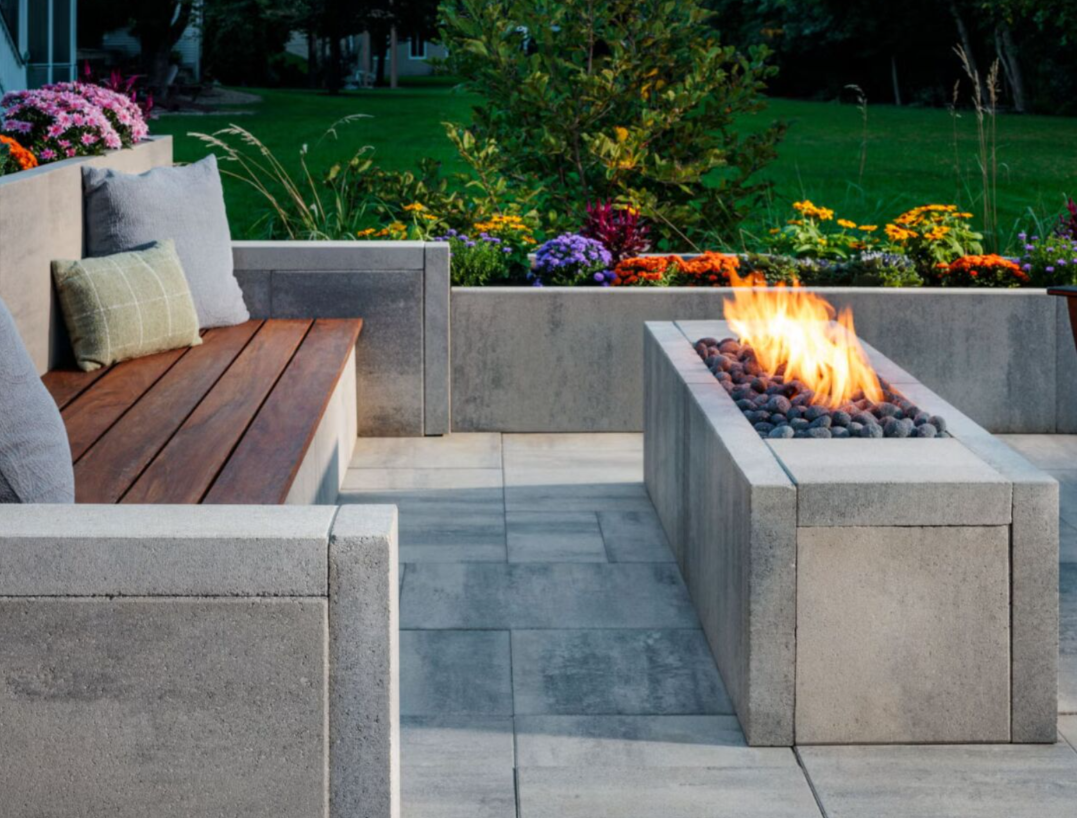
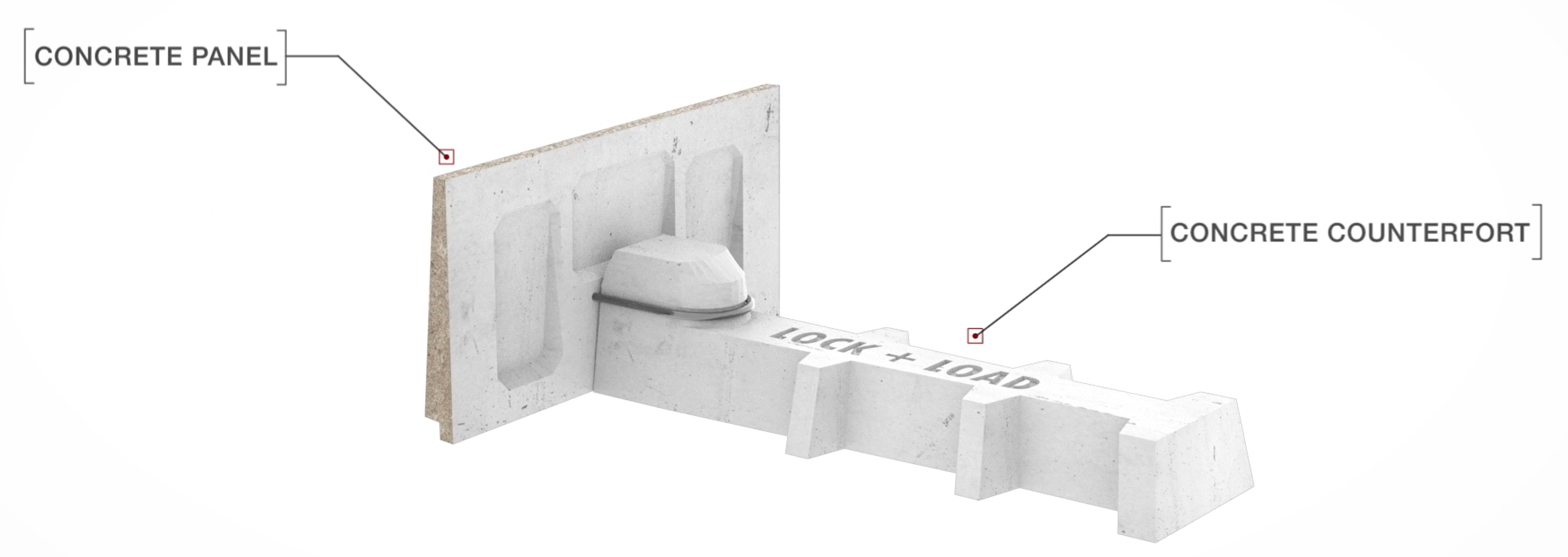
The Lock & Load system uses thin concrete prefabricated faces, approximately 5,000 psi concrete mix, held in place with counterfort attachments. Both the counterfort and the wall itself can be carried by hand. The backfill stabilizes the face, allowing you to continue building the retaining wall regardless of conditions. The wall can be installed to significant heights and sustain heavy loads.
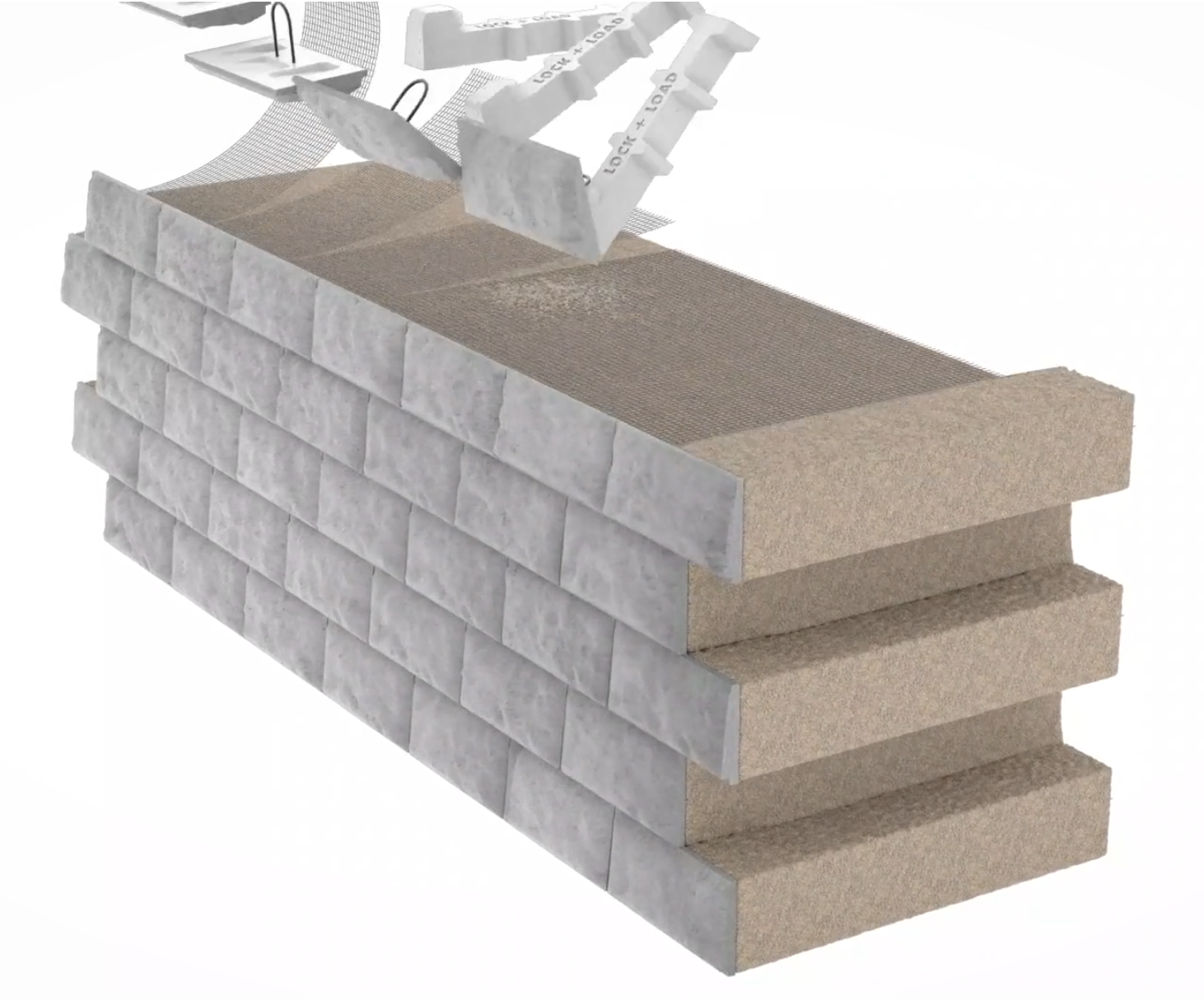
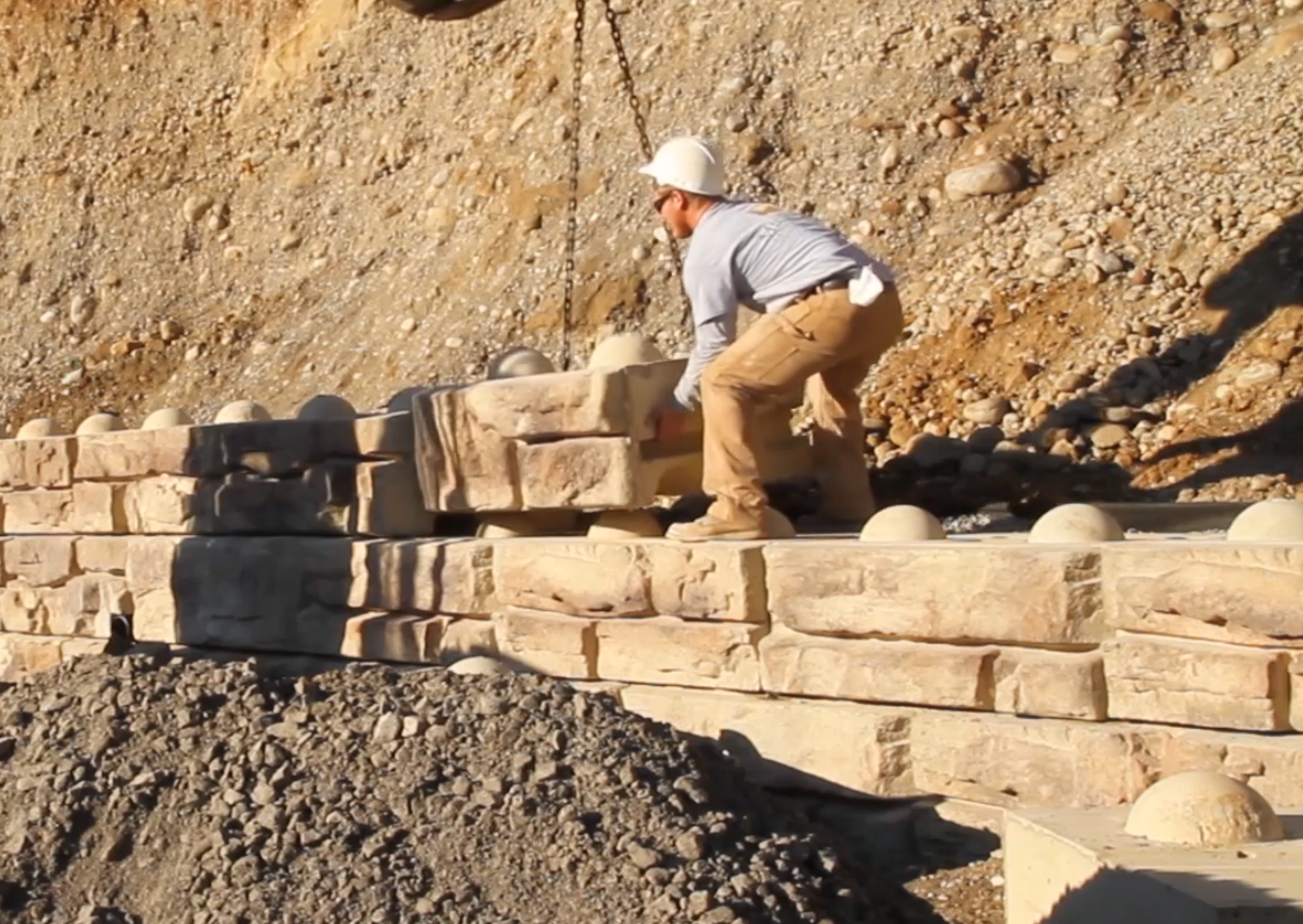
Another prefabricated retaining wall system is the Redi-Rock system uses a relatively heavy system, but they stack like Lego blocks and allows the crew to develop a rhythm and with the use of a crane, it installs very quickly and brings a nice aesthetic. The wall too can be installed to significant heights and sustain heavy loads. Versa-Lok has a similar system.
The Total Cost of Ownership Conversation
The first question contractors ask is about cost. They're comparing beautiful, engineered prefabricated systems to the cheapest thing they can throw in the ground.
That comparison misses the entire point.
You need to calculate total cost of ownership. Factor in reduced labor hours, fewer weather delays, and longer lifespan. When you run those numbers, prefabricated GFRC and concrete systems in general become more profitable even with higher upfront material costs.
Projects can face an average cost increase of 5% to 15% due to weather delays. More severe cases show even steeper impacts. If you eliminate 80% of your weather exposure, you eliminate most of that cost variability.
The second objection is familiarity. Contractors say this isn't what they're used to doing. It's a new paradigm, and change is difficult.
I understand that resistance. Landscapers and hardscapers tend to do things the same way every year. They're trained in specific methods and comfortable with familiar systems, it’s called reps.
But we're in an age of new technologies. These concrete mixes are super strong, will last a lifetime, and represent the material of the twenty-first century. Smart contractors are adopting these systems because the benefits are too significant to ignore.
The Broader Industry Shift Toward Modular Systems
Homebridge Precast isn't the only company recognizing this opportunity. The hardscaping industry is experiencing a wave of innovation around lightweight, prefabricated systems. This trend has been happening in the building industry for decades.
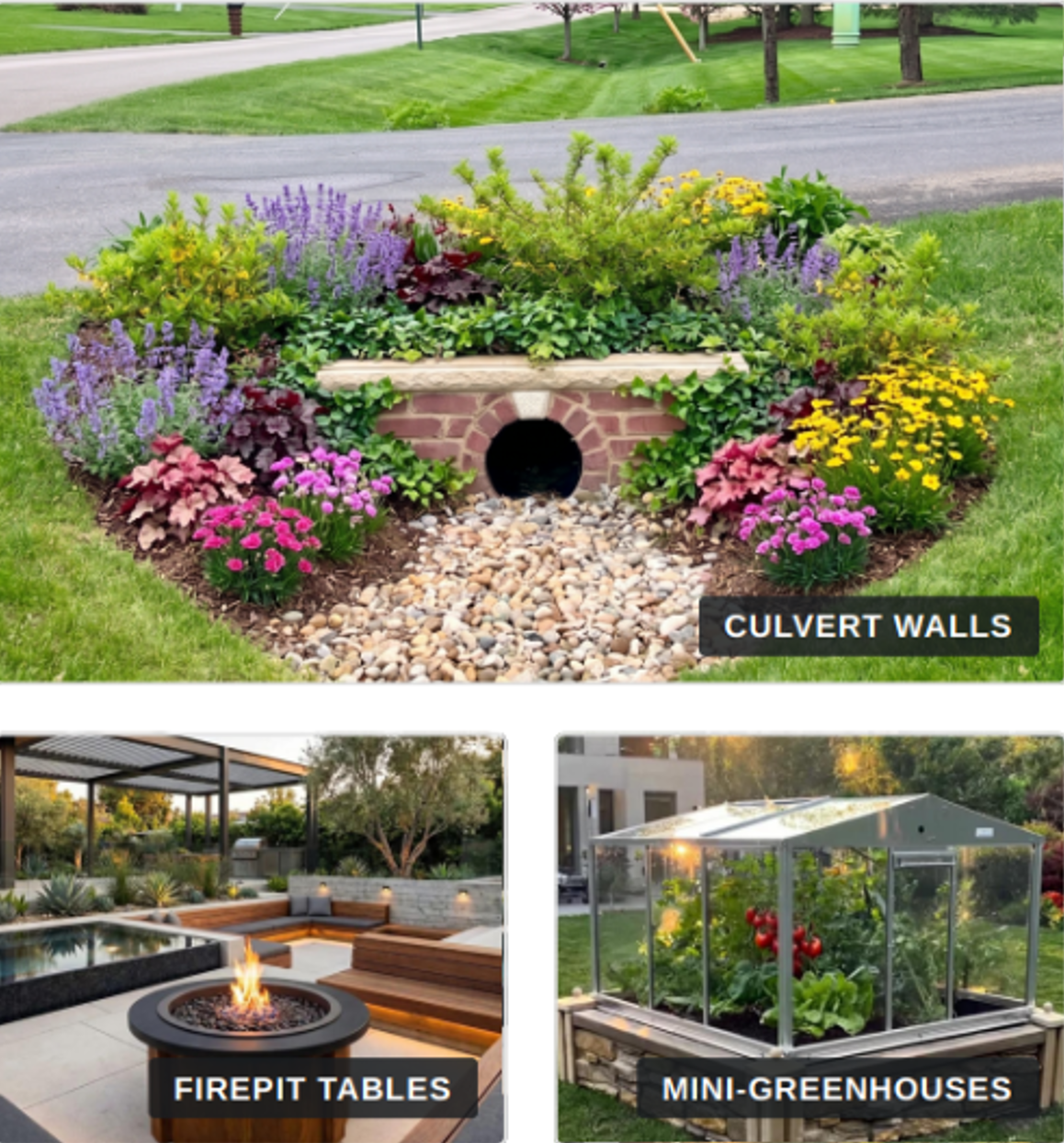
Our product line includes culvert walls (headwalls/endwalls), the first prefabricated GFRC culvert walls of their kind. We manufacture fire pit tables and two types of garden retaining walls: a modular four-by-four system and a garden retaining wall system held in place with mini piles.

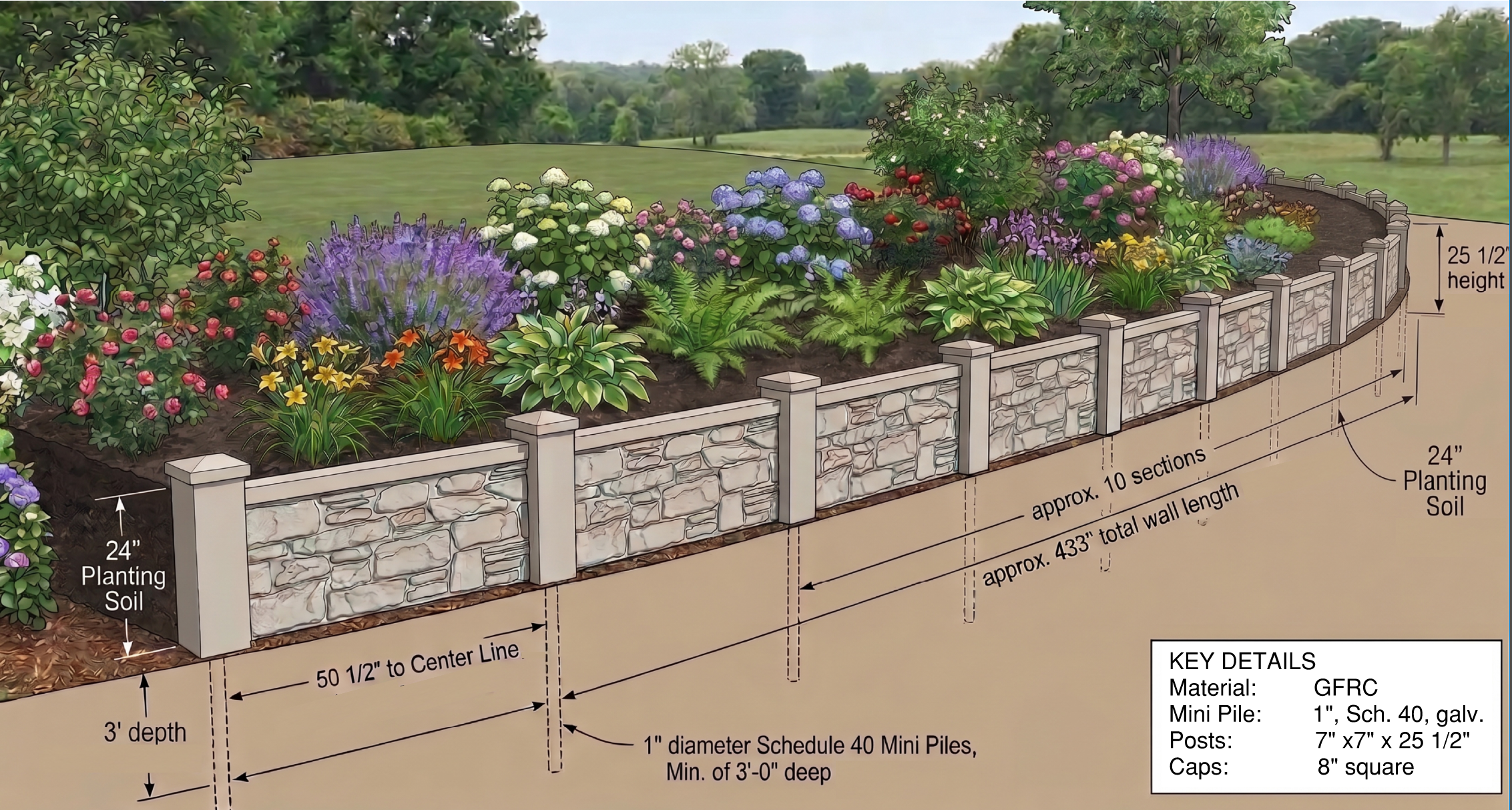
The Garden Retaining Wall System is not limited to certain geometrical shapes. The system can create curved wall designs by having the freedom to adjust the angle of the wall leaving the post by up to 15 degrees in either direction. With a custom order, curved concrete panels are available. The system can also handle grade transitions by allowing part of the system to be buried or by installing various height panels and posts.
These aren't experimental products. They've been tested for over three years in real-world conditions. They're immune to freeze-thaw cycles and deliver the durability contractors need to confidently specify them on projects.
Other manufacturers are developing complementary solutions. The innovation isn't limited to one company or one product category. It's a systematic shift toward reducing labor variability through better materials and smarter installation methods.
Implementation Strategy for Contractors
You don't need to overhaul your entire business model to benefit from prefabricated GFRC systems.
Start by identifying projects where labor variability hits you hardest. Retaining walls with tight timelines. Culvert installations in unpredictable weather windows. Garden walls where material handling consumes excessive crew time.
Integrate prefab systems into those specific applications first. You'll reduce variability within those elements while maintaining your existing methods for other project components.
Track the results. Compare estimated labor to actual labor on prefab installations versus traditional methods. Document the time savings, weather resilience, and crew efficiency improvements.
Educate your team on installation methods. Prefab systems require different techniques than traditional approaches, but the learning curve is shorter than you expect. The systems are designed for faster, simpler installation.
Communicate the benefits to clients. Property managers and homeowners appreciate faster installation, reduced site disruption, and superior durability. These panels offer beautiful alternatives to blocks. They include detailed stacked stone, brick, limestone, and Corten steel veneers cast from real stone. They are all delivered directly to the jobsite. The value proposition extends beyond your internal profitability to customer satisfaction and repeat business.
The Discipline That Makes Everything Work
New materials and systems can transform your profitability. But technology alone doesn't solve the fundamental problem. You need operational discipline.
Track estimated labor versus actual labor on every project. There are new technologies available to help you do that in efficient ways such as programed drone overflights, jobsite cameras, and scanning techniques. See companies such as LMN, Aspire, Jobber, and Workyard to name a few. When there's a gap, investigate why. Was it weather? Material handling? Layout adjustments? Over-design complexity? Equipment issues?
Without that tracking process, you're flying blind. You can't identify where variability hits hardest or where new systems deliver the biggest gains.
Prefabricated GFRC systems give you a tool to control labor variability. But you need the discipline to measure results, identify opportunities, and continuously improve your operations.
The contractors who combine innovative materials with operational rigor will dominate the next decade of hardscaping. The ones who keep doing things the same way every year will keep experiencing the same profit traps that Sam Gembel identified.
Labor variability is killing hardscaper profits. The solutions exist. The question is whether you'll implement it before your competitors do.