The Case for Urban Rooftop Farming: Benefits, Opportunities, and How to Make It Work
Cities are sitting on an untapped agricultural resource: their rooftops.
Across American cities, millions of square feet of roof space absorb heat, shed rainwater, and contribute to urban heat islands. Meanwhile, the same cities struggle with food security, stormwater management, and sustainability goals.
Urban rooftop farming offers a solution that addresses multiple challenges simultaneously. It turns wasted space into productive land. It delivers ultra-fresh food with near-zero transportation. It cools buildings, captures stormwater, and creates jobs. It's not meant to replace rural agriculture—it's a strategic supplement that's especially powerful for institutional food programs, educational settings, healthcare environments, and high-density cities with food access challenges.
The potential is enormous. New York City alone has 15,482 hectares of rooftop surface—445 times the size of existing community gardens.
We've spent years engineering landscape products that survive extreme conditions, and that experience showed us something important: rooftop farming works when cities combine ambitious vision with durable infrastructure that lasts.
Let's explore why rooftop farming deserves attention—and exactly how to make it successful.
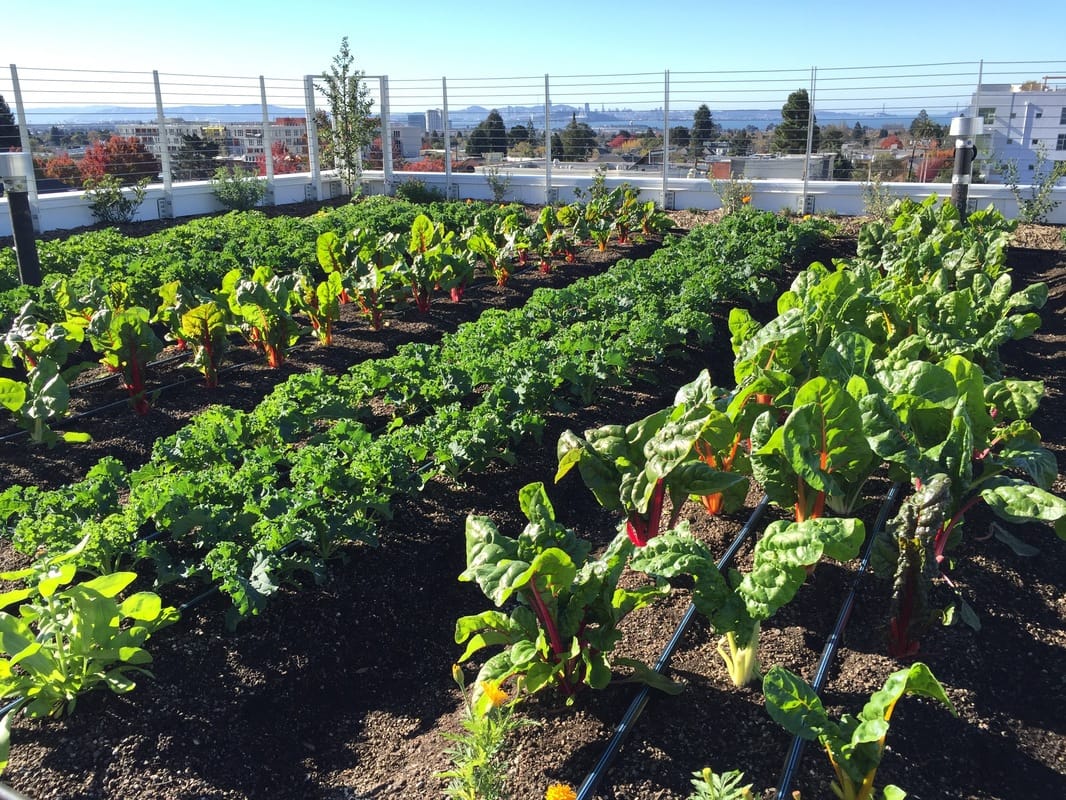
Rooftop farming system with low-profile raised beds. Photo courtesy of Top Leaf Farms.
Why Rooftop Farming Makes Sense: Seven Compelling Reasons
1. It Turns Wasted Space into Productive Land
Most city rooftops just sit there absorbing heat. They're dead space consuming energy without producing value.
Rooftop farms convert that unused acreage into food-producing land without competing for scarce urban real estate. In dense cities where every square foot matters, that's transformational. You're not displacing parks, housing, or businesses—you're activating space that was already there.
2. Ultra-Local Food = Fresher, Cleaner, More Resilient
Food harvested where it's eaten delivers better flavor and nutrition. Leafy greens don't spend days in refrigerated trucks losing vitamins. Herbs reach restaurant kitchens hours after harvest, not weeks.
Near-zero transportation cuts emissions and spoilage. No fuel costs. No refrigeration for long hauls. Restaurants source microgreens, herbs, and specialty greens from buildings in their own neighborhoods.
Cities become less dependent on long supply chains—a significant advantage after COVID-era disruptions exposed how fragile food systems can be. Local production creates resilience when transportation networks face challenges.
3. Buildings Perform Better
Green roofs with farming systems deliver tangible building benefits:
Reduce roof temperatures and urban heat-island effects. Traditional roofs absorb solar radiation and radiate heat. Green roofs reflect and absorb that energy through plant transpiration.
Improve insulation → lower heating and cooling costs. Growing media and plants create thermal mass that regulates building temperature. Energy consumption drops measurably.
Protect roofing membranes, extending roof life. Plants and growing media shield the membrane from UV degradation and temperature extremes. Many roofs last 10-20 years longer with green roof protection.
Many building owners pursue rooftop farms as much for asset protection and operational savings as for food production. The environmental benefits come with financial returns.
4. Smarter Water Use
Rooftop farms often incorporate water-efficient technologies:
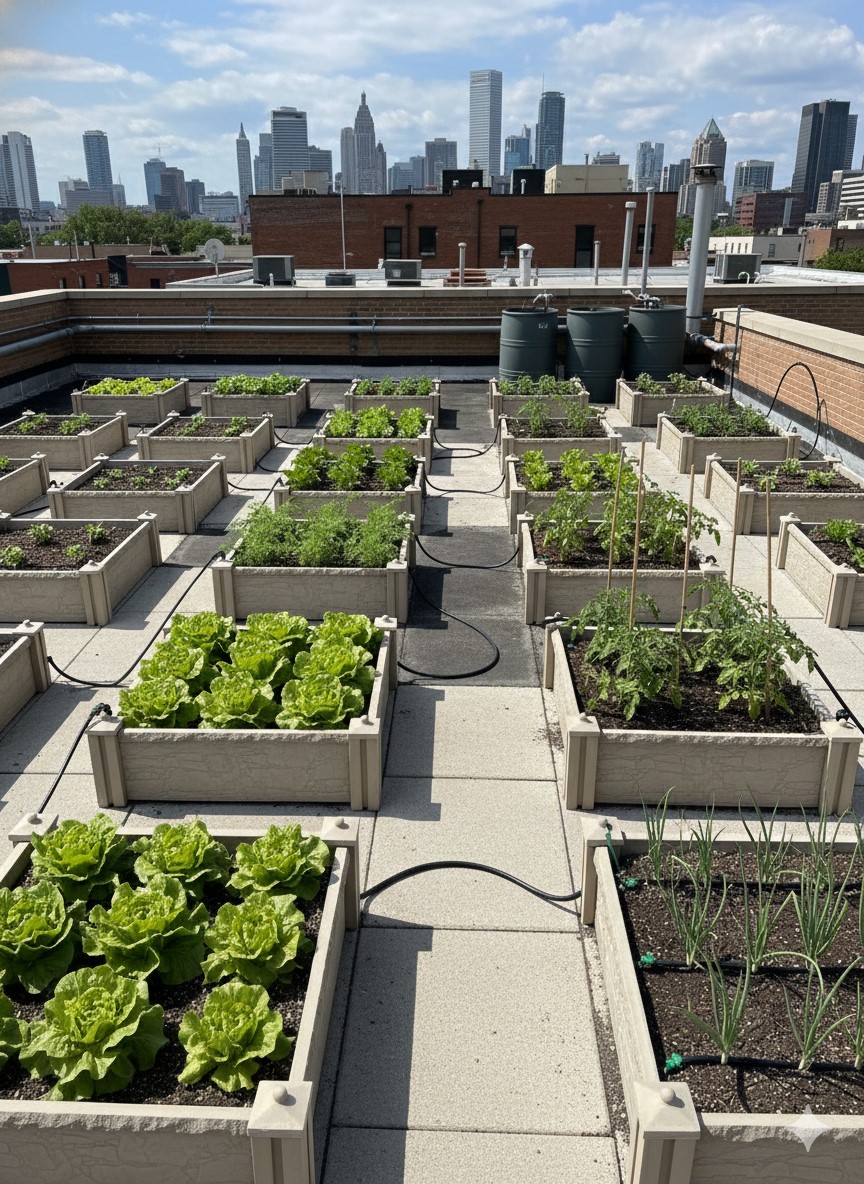
Drip irrigation delivers water directly to plant roots with minimal waste
Rainwater capture systems collect precipitation that would otherwise become runoff
Hydroponic or aquaponic systems recirculate water continuously
These methods can use 70-90% less water than conventional agriculture. Gotham Greens operates 13 hydroponic greenhouse facilities totaling 1.8+ million square feet, using 90% less water and 97% less land than conventional farming while growing up to 30 times more leafy greens per acre.
Stormwater management stands out as one of the most compelling advantages. Rooftop gardens dramatically reduce runoff that overwhelms urban drainage systems. This matters to city water authorities managing aging infrastructure and frequent flooding events—and it creates funding opportunities we'll explore later.
5. Social and Economic Benefits
Rooftop farms create value beyond environmental metrics:
Local jobs and job training: Professional rooftop farms need skilled workers for planting, maintenance, harvesting, and distribution. These positions stay in urban neighborhoods rather than rural areas hours away.
Community engagement and education: Farm-to-school initiatives teach children where food comes from. University programs integrate hands-on learning with sustainability curricula. Community groups build connections through shared gardening experiences.
Mental health and well-being: Access to green spaces and hands-on gardening provides therapeutic benefits, particularly valuable in dense urban environments.
Premium amenity value: Apartments, hotels, hospitals, and offices use rooftop gardens to differentiate properties and attract tenants. University housing draws students interested in sustainability. Therapeutic gardens serve healthcare facilities and senior living communities.
Hospitals and senior living facilities particularly value the therapeutic and nutrition tie-ins. Raised planters allow people with disabilities and older individuals to work comfortably without bending to ground level, expanding participation while creating healing opportunities.
6. Climate and Environmental Wins
The environmental benefits compound:
Absorb CO₂ and airborne pollutants: Plants actively clean urban air while sequestering carbon
Reduce stormwater runoff: Critical for city infrastructure dealing with aging systems and climate-driven precipitation events
Increase urban biodiversity: Pollinators thrive on rooftops, supporting broader ecosystem health
These aren't theoretical benefits. They're measurable improvements that help cities meet sustainability goals while producing tangible value.
7. It Can Actually Pencil Out—If Done Strategically
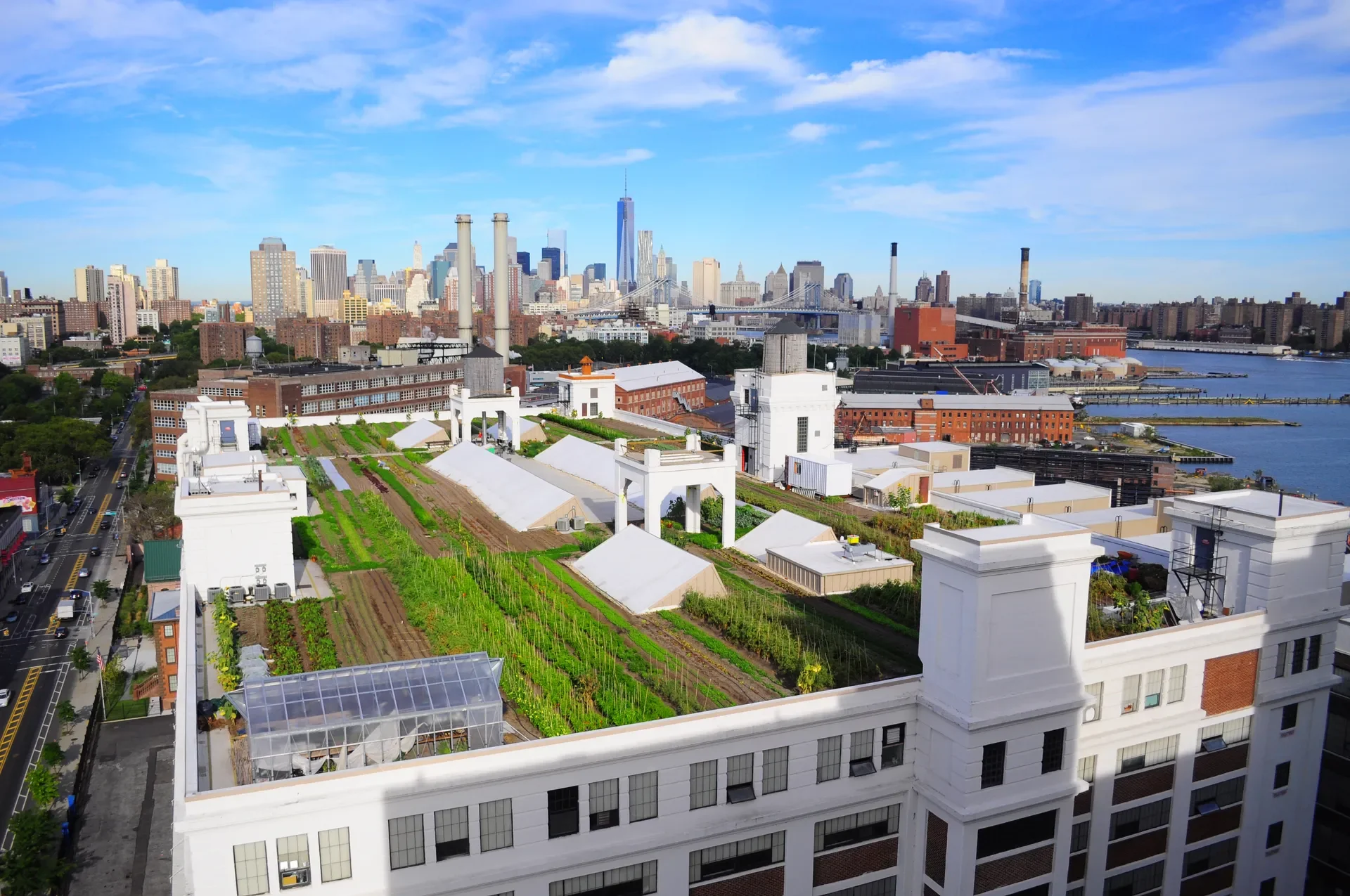
Brooklyn Grange produces 80,000 pounds of organic vegetables annually across 140,000 square feet. That's real production generating real revenue.
The best rooftop farms succeed when they:
Grow high-value crops: Leafy greens, herbs, microgreens, and specialty produce command premium prices from urban restaurants willing to pay for quality and proximity
Partner strategically: Restaurants, schools, hospitals, and corporate cafeterias provide stable demand
Leverage grants and incentives: Green building programs, carbon credits, stormwater fee reductions, and agricultural grants improve economics
Use durable, long-life systems: This is where materials really matter—cheap planters fail fast and destroy the economic model
Brooklyn Grange's business model combines produce sales with diversified revenue streams. They host events, weddings, and workshops. They position rooftop farms as value-add amenities for developers. Multiple revenue streams create resilience beyond crop margins alone.
The Honest Constraints (Because There Are Some)
Rooftop farming delivers tremendous benefits—but it works best under specific conditions.
The structure must handle added load. Most commercial roofs are designed for 20-40 psf (pounds per square foot). Productive rooftop farms require 55-60 psf minimum. Saturated growing media can reach 200-330 psf when fully watered. Engineering assessment isn't optional—it's the foundation of every successful project.
Access, wind, and drainage need thoughtful design. Roof access for transporting harvests, wind protection for plants, and water management systems require upfront planning. These aren't afterthoughts—they're essential infrastructure.
Long-lasting materials make or break success. Cheap planters fail fast in harsh rooftop conditions. Wood rots. Steel rusts. Materials that degrade after 5-10 years destroy the economic model and create maintenance nightmares.
Professional management beats hobby gardening. Successful operations have dedicated champions and mission alignment—whether environmental, educational, or economic. Volunteer enthusiasm that fades when work gets hard doesn't sustain rooftop farms. Institutional commitment does.
When corners are cut, rooftop farms fail. When durability and lifecycle costs are respected from the beginning, they thrive for decades.
Who Pays for Rooftop Farms? Understanding the Multi-Payer Model
The benefits are clear. But who actually funds rooftop farming infrastructure?
The answer is rarely a single entity. The most successful rooftop farms use blended funding models where multiple stakeholders contribute based on the value they receive. Understanding these funding sources is critical for making projects happen.
Building Owners and Developers
What they see: Building owners don't see a "farm." They see longer roof lifespan (often 10-20 additional years), lower HVAC costs, higher rents and property values, and ESG/green-building credentials.
How it's financially justified: Rolled into capital expenditures for the building. Counted as a green roof or sustainability upgrade. Offset by energy savings, reduced roof replacement costs, and higher net operating income.
Common building types: Multifamily apartments, mixed-use developments, office buildings, hotels seeking differentiation.
Key insight: Developers pay when the system is durable. Cheap planters scare them off—they see liability and future replacement costs. Long-life systems (25+ years) qualify as capital assets and close deals.
Cities and Public Agencies
What they're buying: Cities aren't funding food production—they're investing in stormwater mitigation, heat-island reduction, climate resilience, and food access in underserved areas.
How they fund it: Green infrastructure grants, stormwater fee credits, climate action budgets, and urban agriculture initiatives.
Typical payers: City sustainability departments, water and sewer authorities, housing authorities.
Key insight: If the farm reduces runoff or peak heat, it can be funded like infrastructure rather than agriculture. That shifts it from discretionary spending to essential capital improvement.
Institutions (The Sleeper Winner)
Institutions have missions and budgets naturally aligned with rooftop farming.
Hospitals and healthcare systems fund rooftop farms for patient nutrition, therapeutic horticulture, staff wellness, and community health outcomes. Funding often comes through capital improvement budgets, philanthropy, or community benefit requirements for nonprofit hospitals.
Schools and universities invest for education, nutrition programs, STEM learning, and farm-to-school compliance. Funding sources include USDA grants, state education funds, and foundations.
Senior living and VA facilities pay for therapy, accessibility, mental health benefits, and fresh food on-site. These buyers care deeply about raised height for accessibility, longevity (no splinters, rust, or rot), and safety.
Key insight: Institutional buyers value permanence and mission alignment. A 25-year rooftop farm system supports programs across multiple budget cycles.
Nonprofits and Foundations
Nonprofits fund outcomes: food justice, workforce training, community resilience, and health equity. The rooftop farm becomes a flagship project demonstrating impact. Building owners often contribute roof access or matching funds.
Key insight: This is where storytelling matters. Connecting rooftop farms to resilience, self-sufficiency, and community dignity attracts philanthropic support.
Food Operators and Urban Farm Companies
Some operators lease roof space cheaply and install their own production facilities. They sell produce to restaurants or institutions below. This model works best when roof access is easy, crops are high-margin, and infrastructure lasts long enough to justify the investment.
Blended Models (Most Common)
In reality, the most successful rooftop farms combine multiple funding sources:
Example: Developer pays for structure and raised beds. City contributes via stormwater or green-roof grants. Nonprofit funds education programming. Food operator runs the farm and shares revenue.
No single entity carries the full load—and everyone achieves their goals. This is how rooftop farming scales.
How to Make It Work: Solving the Structural Challenge
Understanding who pays leads naturally to how to execute successfully.
Structural capacity stands as the first consideration. This doesn't mean rooftop farming is impossible—it means planning matters from day one.
Older buildings in northern cities often have the structural capacity for agriculture. Buildings constructed in the 1920s-1930s in cities like Detroit were typically built with concrete or steel structures wrapped in concrete. Their roof loads were designed for heavier requirements than modern commercial buildings.
Developers building new apartment buildings, condos, or university housing can account for heavier roof loads in their pro forma calculations. Rooftop gardens work as amenities that attract tenants and justify the structural investment.
Brooklyn Grange demonstrates what proper planning achieves. Their installation required craning 3,000 pounds of soil sacks seven stories up over six days. They don't use actual soil—their engineered mix contains stones that break down slowly to reduce weight while maintaining nutrition.
Lightweight systems make rooftop farming accessible to more buildings. We design GFRC raised beds to weigh approximately 225 pounds when installed. The modular four-foot system allows spacing between planters, distributing weight more evenly across the roof structure. Two people can install a complete system in about two hours.
Engineering assessments determine what's possible for specific buildings. That's a requirement, not an option—but it's a solvable challenge with the right approach.
Choosing Materials That Last: The Durability Advantage
Material selection determines whether rooftop farms succeed long-term or become maintenance burdens.
The rooftop environment is harsh. Constant UV exposure. Temperature extremes. Moisture. Freeze-thaw cycles in northern climates. Materials that work fine at ground level fail quickly on rooftops.
Wood planters last 5-10 years in these conditions. Steel planters might reach 10-20 years with moderate maintenance, but rust becomes inevitable. Even Cor-Ten steel degrades under constant exposure. That creates replacement cycles that undermine long-term economics.
Durable materials transform the economic equation. We've tested glass fiber reinforced concrete (GFRC) for over three years in conditions that replicate rooftop extremes. The material passed 300+ freeze-thaw cycles under ASTM C666 testing without degradation. It's four times stronger than regular concrete at 12,500 psi compressive strength, with flexural strength exceeding 2,000 psi.
The expected lifecycle is 25+ years. It might reach 30-50 years. We don't know the upper limit yet because the material is that durable.
Compare the options:
Wood planters: 5-10 year lifespan, high maintenance, high replacement likelihood
Steel planters: 10-20 year lifespan, moderate maintenance due to rust, medium replacement likelihood
GFRC planters: 25+ year lifespan, minimal maintenance, low replacement likelihood
The difference matters for lifecycle costs and institutional commitment. GFRC qualifies as a capital asset on financial statements. Wood often doesn't—it's classified as an amenity. That affects how organizations budget for and justify rooftop farming projects.
Choosing materials engineered for rooftop conditions isn't about premium aesthetics. It's about building infrastructure that lasts long enough to deliver on the environmental and economic promises.
Fast Installation: Reducing Barriers to Implementation
Traditional rooftop farm installation takes weeks or months. That clashes with seasonal planting windows and creates high labor costs.
Prefabricated systems change the equation dramatically. Our GFRC raised beds install in approximately two hours with two people. That's an 87.5% reduction compared to traditional methods.
Speed creates multiple advantages:
Labor costs drop significantly. Controlling labor variability is the biggest challenge contractors face. Prefabricated solutions eliminate most of that uncertainty. Installation becomes predictable and affordable.
Faster time-to-production generates revenue sooner. Miss a planting window with traditional installation, and you're waiting another season. Quick installation means selling herbs and microgreens weeks or months earlier.
Simplified logistics reduce complexity. Projects don't require extensive construction crews, specialized equipment for weeks on end, or complex coordination. Two people and a few hours makes rooftop farming accessible to organizations that couldn't justify major construction projects.
The four-foot modular design maximizes yield while maintaining easy access for tending plants. Three-foot spacing between planters provides room for movement and maintenance. The system works for professional operations and community gardens alike.
Reducing installation barriers means more organizations can test rooftop farming without massive upfront commitments. That accelerates adoption and learning across the sector.
Planning for Long-Term Success: Maintenance and Operations
Successful rooftop farms require realistic planning for ongoing operations.
Water management systems need integration from the start. Rainwater collection makes sense both economically and environmentally. Efficient irrigation reduces water consumption while ensuring plants receive consistent moisture.
Roof access for transporting harvests needs consideration during design. Commercial operations moving significant produce volumes need practical logistics. Space for processing crops matters at scale.
Material quality determines whether maintenance stays manageable or becomes overwhelming. Cheap systems fail and require replacement every few years. Maintenance costs spiral. Projects lose their champions when the work exceeds expectations.
Permanent infrastructure changes that calculation. Materials engineered for rooftop conditions require minimal maintenance year after year. That allows operators to focus on growing food rather than replacing components.
Institutional commitment matters as much as physical infrastructure. Successful operations have dedicated champions who maintain program ownership. They value permanence and safety. They plan for long horizons rather than depending on volunteer enthusiasm that fades when work gets hard.
Professional operations work better than hobby gardens for this reason. Mission alignment—whether environmental, educational, or economic—sustains commitment through inevitable challenges.
These requirements aren't barriers. They're planning considerations that separate successful long-term operations from abandoned experiments.
Policy Support: Creating Enabling Frameworks
Cities can accelerate rooftop farming adoption through supportive policies and programs.
New York City updated their zoning code in 2013 with "Zone Green" provisions. They now require roofs used for gardens to handle minimum 100 psf for assembly purposes. The city's Community-Based Green Infrastructure Program provides grants as part of a 20-year plan.
International examples demonstrate what's possible. Seoul's 2012 ordinance requires all public buildings and new private developments over 10,000 square feet to allocate 10-20% of roof space to farming. Tokyo offers 50% property tax reductions for buildings dedicating 25%+ of roof space to agriculture.
Those policy frameworks enable scale.
American cities can adopt similar approaches. Federal USDA grants could support farm-to-school programs. Local water authorities have financial incentive to participate given stormwater management benefits. Tax incentives reward developers who include rooftop agriculture in projects.
Building codes that clarify requirements remove regulatory uncertainty. Knowing structural standards, safety requirements, and approval processes helps developers budget and plan confidently.
The funding model often involves partnerships between city governments, water authorities, professional organizations, and developers. Multiple stakeholders contributing creates resilience and shared commitment.
Policy support doesn't mean government operates rooftop farms. It means removing barriers and creating incentives that allow private operators, nonprofits, and community groups to succeed.
Making It Happen: Practical Steps Forward
The case for urban rooftop farming is compelling. Environmental benefits, economic opportunity, social impact—all from utilizing space that already exists.
Making it happen requires combining vision with practical execution.
Start with structural assessment. Engineering analysis determines what's possible for specific buildings. Older buildings in northern cities often have capacity. New developments can plan for rooftop agriculture from the beginning.
Choose materials engineered for rooftop conditions. Durability determines whether projects succeed long-term or become maintenance burdens. Materials that last 25+ years change the economic equation compared to those requiring replacement every 5-10 years.
Prioritize fast installation systems. Prefabricated components that install in hours rather than weeks reduce costs and eliminate seasonal timing problems. Accessibility improves when systems don't require major construction projects.
Plan water management and logistics upfront. Rainwater collection, efficient irrigation, harvest transport, and processing space aren't afterthoughts. They're essential infrastructure that needs integration from the start.
Build institutional commitment. Successful operations have dedicated champions and mission alignment. Whether environmental, educational, or economic goals drive the project, long-term commitment matters more than initial enthusiasm.
Leverage partnerships and funding. City governments, water authorities, developers, and community organizations each have reasons to support rooftop farming. Collaborative funding models create resilience.
The technology exists. Lightweight growing media, durable materials, efficient systems—the tools are available. We've spent years developing GFRC products that address rooftop farming challenges specifically. The material uses recycled expanded glass to reduce weight while maintaining strength. It's immune to freeze-thaw cycles that destroy other materials. It installs quickly with modular components and requires minimal maintenance for 25+ years.
Here's what makes the difference:
For developers: Lifecycle cost and roof protection make the investment viable
For institutions: Durability, safety, and accessibility support mission goals across decades
For cities: Long service life means infrastructure-level reliability
For grants: Permanence matters when funding capital improvements
A 25-year system is a capital asset. A 5-year planter is a liability that undermines every benefit rooftop farming promises.
That's the kind of infrastructure rooftop farming needs to scale from boutique experiments to essential urban infrastructure.
Urban agriculture producing fresh food steps from where it's consumed isn't just a vision—it's achievable right now with the right combination of planning, durable materials, and institutional commitment. Cities have enormous rooftop potential waiting to be activated.
The question isn't whether rooftop farming makes sense. The benefits are clear. The question is how quickly cities, institutions, and developers can implement durable solutions that deliver on those promises for decades to come.