The Sustainable Hardscape Buyer's Guide: Questions That Actually Matter Before You Buy
You're about to spend thousands on hardscape materials. The salesperson promises durability. The website claims sustainability. The price tag makes you wonder if you're buying materials or investing in a small island.
Here's what nobody tells you: most hardscape purchases fail because buyers ask the wrong questions.
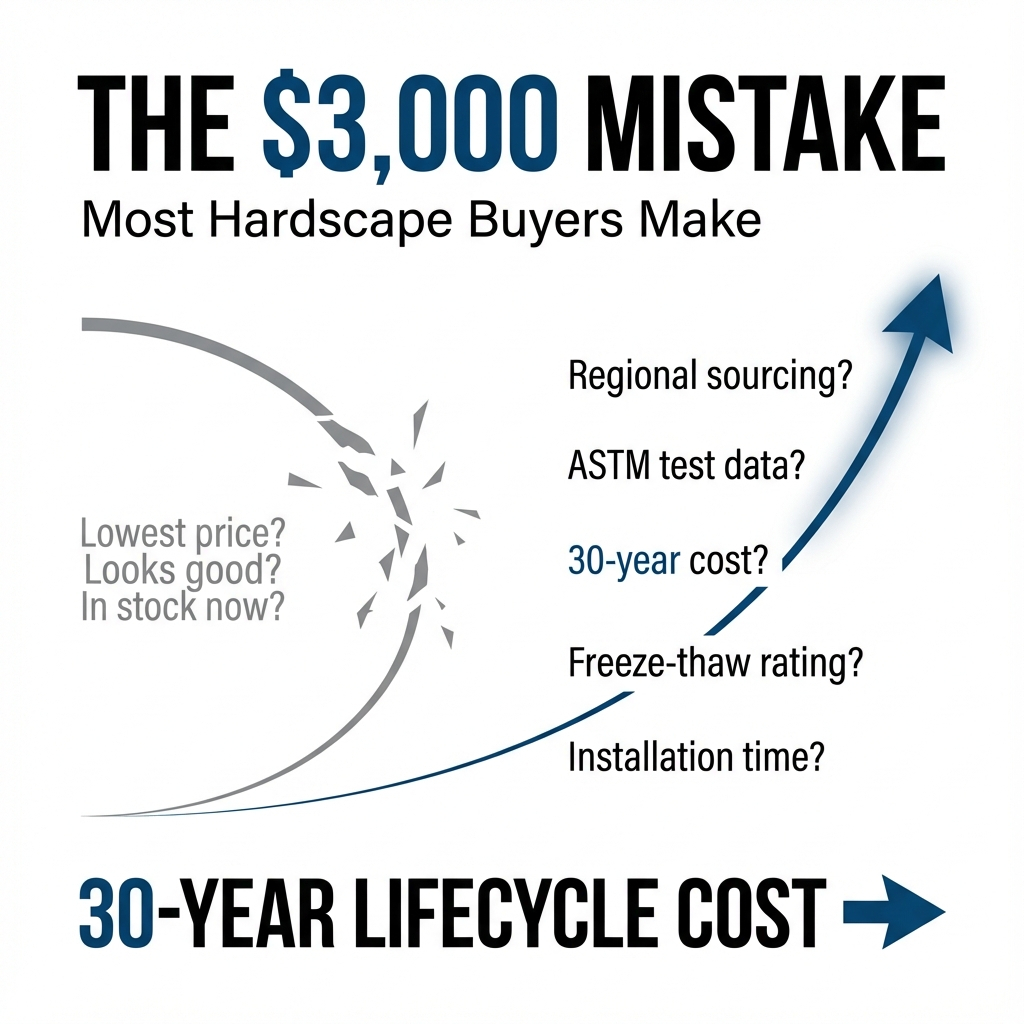
You focus on upfront cost while ignoring the $3,000 replacement in five years. You chase certifications that sound impressive but mean nothing. You compare materials without understanding what performance actually looks like in your climate.
This guide gives you the questions that separate marketing claims from materials that deliver. You'll learn which certifications matter, what performance benchmarks reveal about real-world durability, and how to calculate the math that salespeople hope you'll skip.
Start With the Certification Question Most Buyers Miss
Certifications can validate quality or they can be expensive wall decorations for manufacturers. You need to know the difference.
LEED credits matter for green building projects. They're not just environmental theater. Projects pursuing LEED certification need materials that contribute to specific credit categories. LEED v5 now requires tracking embodied carbon impacts for structural, enclosure, and hardscape materials. If your project qualifies, this isn't optional.
For natural stone, look for ANSI/NSC 373 certification. This standard identifies quarries and sources meeting environmental responsibility benchmarks. It's the difference between stone harvested ethically with environmental controls and materials sourced from operations with questionable practices.
Sustainable landscaping practices have grown 40% over the past five years. Certifications help you identify which materials participate in that trend versus which ones just talk about it.
But here's what matters more than any certification: ask where the material comes from and how far it traveled.
Beautiful stone from China or Europe might cost less upfront, but the carbon footprint from transportation undermines any sustainability claims. Materials harvested unethically overseas carry hidden costs that certifications can't fix.
💡 Pro tip: Request documentation showing regional sourcing. Local or regional materials minimize transportation carbon footprint while supporting responsible supply chains.
The GFRC Performance Standard You Need to Understand
Glass Fiber Reinforced Concrete (GFRC) represents a material category most buyers have never heard of. That's a problem because GFRC outperforms traditional concrete in nearly every category that matters.
Start with the composition. GFRC uses less cement than equivalent concrete and incorporates significant quantities of recycled materials as pozzolan. This qualifies it as sustainable before you even consider performance.
The performance numbers tell the real story:
Flexural strength up to 4,000 psi compared to standard concrete's much lower rating
Compressive strength of 12,500 psi versus typical concrete at 3,000-4,000 psi
Four times stronger than regular concrete in real-world applications
Superior freeze-thaw resistance that outlasts precast concrete and even some natural stone
Here's the detail that changes everything for long-term durability: GFRC uses glass fibers for reinforcement instead of steel.
This means it cannot rust. You can use it under salt water and in marine environments. It performs in conditions where traditional reinforced concrete fails within years.
GFRC has been tested through accelerated aging tests in laboratories and proven in real-life installations. The expected lifespan matches or exceeds precast concrete while performing better in high-moisture or salt-spray environments.
When you're evaluating materials, ask about ASTM testing. Multiple ASTM standards apply to GFRC, providing objective performance data. Materials tested for over three years in real-world conditions give you confidence that laboratory claims translate to actual durability.
The Real Math: Why Lifecycle Cost Beats Upfront Price Every Time
You're comparing materials based on price per square foot. That's exactly what manufacturers of cheap materials want you to do.
Lifecycle cost over 10-30 years reveals which materials actually save money.
Consider white limestone versus concrete pavers. The limestone costs more upfront. Over a 10-30 year horizon, well-chosen limestone often has lower lifecycle cost because of fewer replacements and lower long-term maintenance. This assumes correct installation and maintenance, but the principle applies across material categories.
GFRC panels require minimal maintenance due to their durability and resistance to wear and tear. This reduces long-term maintenance costs significantly compared to materials that need regular sealing, repair, or replacement.
Here's the cost breakdown you need for informed decisions:
Basic hardscaping costs:
General range: $5-25 per square foot depending on materials, labor, and location
Basic concrete: $6-10 per square foot
Stamped or stained concrete: $12-18 per square foot
Pavers and bricks: $5-25 per square foot
Natural stone (granite, limestone, slate): $15-30 per square foot
Premium materials: up to $50 per square foot
These numbers only tell half the story. Installation time dramatically affects total project cost.
Traditional stick framing features lower hourly labor rates but extends the overall timeline significantly. Prefabricated components can halve on-site installation durations compared to conventional methods.
For landscape applications, large precast pavers cost less to install because they don't require as much labor as pouring concrete or masonry work. Prefabricated fire pits, outdoor seating, and barbecue islands are typically more cost effective than custom-built structures.
When materials install in one-eighth the time of standard methods, you're not just saving labor costs. You're reducing the variability that makes contractors nervous and projects run over budget.
⚠️ Critical calculation: Multiply the upfront material cost by expected replacements over 30 years. Add maintenance costs annually. Compare that total to premium materials with minimal maintenance. The premium option often costs less.
Installation Time: The Hidden Value Most Buyers Ignore
You're focused on material cost. Your contractor is worried about labor.
Prefabrication changes the economics of landscape projects.
Prefabricated mass timber components can halve on-site framing durations. The same principle applies to hardscape materials. Products that arrive ready to install eliminate the skilled labor bottleneck that delays projects and inflates costs.
Consider what happens with traditional installation methods:
Multiple site visits for preparation, installation, and finishing
Weather delays that extend timelines
Skilled labor requirements that limit contractor availability
Quality variation based on installer experience
Curing time that prevents immediate use
Prefabricated elements eliminate most of these variables. Products tested for over three years arrive ready to perform. Installation happens in hours instead of days. The project finishes on schedule.
For contractors, this solves the fundamental challenge of their business: controlling labor costs and variability.
Labor represents the biggest uncertainty in landscaping projects. Materials that reduce installation time by 87.5% transform project economics. Contractors can take on more projects. Homeowners get results faster. Everyone wins except manufacturers of materials that require extensive on-site labor.
Red Flags That Reveal Problem Materials Before You Buy
Some warning signs appear obvious in hindsight. You need to spot them before writing the check.
Vague sourcing information signals problems.
Beautiful stone found at material yards has often traveled thousands of miles from China or countries in Europe. The material costs less because it's harvested cheaply, sometimes unethically. If the supplier can't tell you exactly where materials originate, assume the worst.
Recycled rubber mulches are not sustainable hardscaping solutions. Despite marketing claims about recycling, these materials don't belong in quality landscape projects. They degrade, leach chemicals, and require replacement.
Missing ASTM test data means unproven performance.
Reputable manufacturers provide testing documentation. If a company claims superior durability without ASTM testing to back it up, you're buying marketing instead of materials.
The carbon footprint of construction materials faces increasing scrutiny. Many products now include recycled content or reduce cement use to lower carbon emissions. Materials without this information are behind the curve.
Watch for these specific red flags:
No regional sourcing documentation
Absence of third-party testing or certification
Vague warranty terms or short warranty periods
No information about freeze-thaw performance in your climate
Missing details about maintenance requirements
Inability to provide case studies or long-term installation examples
Products that require frequent sealing or treatment
Materials with steel reinforcement in high-moisture applications
Here's the question that exposes problems fast: "What maintenance does this require in years 5, 10, and 20?"
If the answer is vague or focuses only on the first few years, you're looking at a material that won't age well.
Performance Benchmarks That Predict Real-World Durability
Laboratory testing reveals how materials perform under controlled conditions. Real-world installations show what happens when weather, time, and use apply pressure.
Temperature performance matters more than most buyers realize.
Many sustainable materials are designed to handle wide temperature swings. Composite decking resists cracking in freezing weather. Recycled concrete performs well in warmer regions. But you need specific data for your climate.
Materials immune to freeze-thaw cycles survive northern winters without degradation. This isn't just about cold tolerance. It's about the expansion and contraction that happens when water freezes in material pores. Traditional concrete fails this test repeatedly. GFRC passes it.
Moisture resistance determines longevity in most climates.
Materials with steel reinforcement corrode in high-moisture environments. This includes coastal areas, regions with high rainfall, and anywhere salt spray occurs. Glass fiber reinforcement eliminates this failure mode entirely.
GFRC performs better than precast concrete in environments with salt spray or high moisture because there's no steel reinforcement to corrode. This makes it suitable for applications where traditional concrete fails within years.
Strength specifications that actually matter:
Compressive strength: Measures resistance to crushing forces. Look for minimum 10,000 psi for premium applications.
Flexural strength: Indicates resistance to bending and cracking. Minimum 2,000 psi for landscape applications exposed to loads.
Freeze-thaw resistance: Should withstand minimum 300 cycles without degradation in cold climates.
Water absorption rate: Lower is better. High absorption leads to freeze-thaw damage and staining.
Ask manufacturers for documentation on all four specifications. Missing data suggests the material hasn't been properly tested or won't perform well.
Making the Decision: Your Action Plan
You've got the questions. Now you need a process for evaluating materials systematically.
Step 1: Define your performance requirements
List the specific conditions your hardscape will face:
Climate extremes (temperature range, freeze-thaw cycles)
Moisture exposure (rainfall, drainage, water features)
Load requirements (foot traffic, vehicle weight, furniture)
Aesthetic goals (color, texture, style)
Maintenance tolerance (time and cost you're willing to invest)
Step 2: Request documentation from manufacturers
Don't accept marketing claims. Get:
ASTM testing results
Sourcing and origin documentation
Warranty terms in writing
Installation requirements and timeline
Maintenance schedule and costs
Case studies from your climate region
Step 3: Calculate true lifecycle costs
Create a 30-year comparison:
Initial material cost
Installation labor and timeline
Annual maintenance costs
Expected replacement frequency
Replacement costs (material and labor)
The material with the lowest total cost over 30 years wins, assuming it meets your performance requirements.
Step 4: Verify contractor experience
The best material fails with poor installation. Confirm your contractor has experience with your chosen material. Request references from similar projects. Prefabricated materials reduce installation complexity, but expertise still matters.
The Bottom Line on Sustainable Hardscape Materials
You're making a decision that affects your property for decades. The questions you ask now determine whether you're satisfied in year one or still enjoying the results in year twenty.
Focus on lifecycle value instead of upfront cost. Demand documentation instead of accepting claims. Prioritize materials with proven performance in your specific climate and application.
GFRC represents the performance standard for durability, sustainability, and installation efficiency. Materials that install in one-eighth the time while lasting 50+ years change the economics of landscape projects.
The right questions lead to materials that deliver. The wrong questions lead to replacements, repairs, and regret.
You now have the questions that matter. Use them.